Orange underpainting
The light house: A love storyOrange underpainting is Blake McGrath’s distinctive preparation of the canvas with a bright orange ground beneath the visible layers of oil paint. He presents it not as decoration but as a technical principle: the color remains partly perceptible through the finished work, lending the image warmth, light, depth, and a realism that cannot be achieved on an untreated white surface. The method also embodies the novel’s larger movement from concealed pain toward renewed artistic expression, because the same hidden layer underlies Blake’s famous earlier paintings, his portrait of Connie Dixon, and his decision to return to painting after blindness and grief.
Definition and Technique
Blake explains that every painting he has made was prepared with the same bright orange undercoat. Connie initially doubts that a canvas painted the color of ripe fruit can serve as a serious foundation, but Blake demonstrates the method by showing her orange residue along the edges of several familiar paintings. The trace is normally hidden by the completed image, yet it proves that the concealed ground is not an isolated experiment: it is a consistent part of his practice and one of the secrets behind the work she has long admired.
For Blake, white canvas is a mistake for an artist seeking realism because the finished painting lacks an intangible quality: warmth. He argues that everything in nature gives off warmth, including ordinary inanimate objects, and that the orange ground allows this warmth to glow through the upper layers regardless of how thickly the paint is applied. The result is a radiating sense of sunlight and atmosphere, with depth produced not only by the visible colors but by the controlled survival of the color beneath them. The underpainting therefore functions as an active optical foundation rather than a disposable preliminary coat.
Canvas Preparation and Precision
The orange layer depends on an earlier stage of preparation. When Connie chooses a horizontal canvas roughly two feet wide and sixteen inches high, Blake reveals that the surface has first received five coats of primer before the orange underpainting is applied. Connie is shocked because conventional priming does not normally require so many coats, but Blake treats the procedure as essential to the clarity of the final image.
His explanation is based on the physical weave of canvas. An untreated or insufficiently prepared surface resembles a corrugated iron roof: a brush misses the hollows and deposits too much paint on the raised ridges. Five coats of primer fill most of the roughness while retaining enough of the fabric pattern for the finished work to remain recognizably oil on canvas. Blake’s aim is a smoother working surface on which lines can remain clear and crisp. He contrasts this precision with the natural forms he paints, observing that waves do not have fuzzy edges and boats do not have blurred outlines. The orange ground thus works together with the primer: the primer controls the surface, while the orange supplies the warmth and depth that the visible paint alone would lack.
Application to Seascapes and Portraiture
Blake insists that the method matters in a portrait as much as in a seascape, perhaps even more. This matters to Connie because he is preparing to teach her and to begin work on her portrait. The underpainting is not restricted to the maritime subjects associated with his reputation; it is a general principle of his realism, capable of shaping the emotional and physical presence of a human face as well as the atmosphere of the ocean.
The technique also helps explain the particular character Connie notices in Blake’s brushwork. His oils do not appear thickly piled on the surface to manufacture texture and dimension. Instead, the paint seems to melt into the canvas. Blake regards this as a style that emerged from his way of working rather than as a consciously advertised innovation, but the orange ground gives that apparently seamless surface a hidden structure. What looks effortless is supported by repeated preparation, controlled layers, and a color that remains active beneath the image without openly announcing itself.
Hidden Ground and Grief
The concealed orange layer resonates with the hidden emotional history of Blake’s paintings. The woman appearing in several of his works is not an unknown model but Chloe, whom Blake imagines as the raven-haired young woman she might have become if she had lived. He sends those paintings into the world so that Chloe might somehow recognize herself and understand that she was remembered and loved. The visible image is therefore built over an absence, just as the visible paint rests over a color that the viewer may not immediately see.
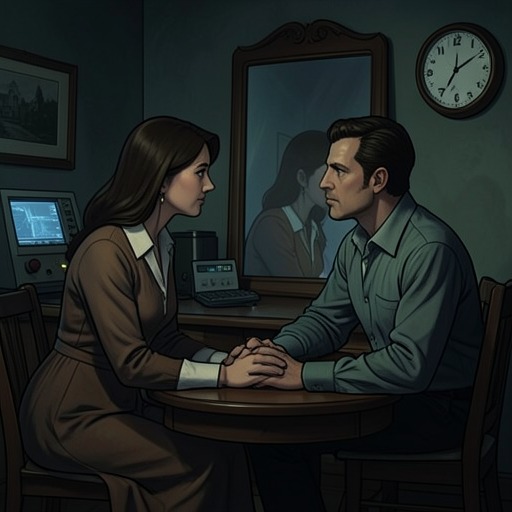
Blake’s grief also takes material form in the light house, the Mason house whose lights remain on day and night so that fishermen can see it for miles out to sea. He leaves the lights burning because he wants Chloe to find her way home. At sunset, he and Ned send a red rose into the ocean, while Ned waits on the empty beach through the night for Chloe’s return. These rituals are loss-oriented acts of continued attachment, but they exist beside movements toward recovery: Blake shares the pain of Chloe’s death with Connie, dusts Chloe’s bedroom, changes its sheets, and briefly feels his old self rising from despair. The underpainting provides a useful artistic parallel to this divided process. What has been buried is not erased; it continues to radiate through the life that is being rebuilt above it.
Transformation and Artistic Return
After Blake and Connie confront the meaning of Chloe’s death, he eventually performs a final farewell. He kisses the last red rose, throws it into the foaming waves, and tells Chloe that she will always be loved. He declares that he can no longer continue grieving in a way that leads only toward darkness and that he will instead celebrate her smile in sunshine and listen for her laughter on the wind. When he returns from the beach, Connie waits on the porch, and they weep together. Inside the house, she turns off the lights one by one, ending the light house ritual without denying Chloe’s place in Blake’s memory.
The same movement from mourning toward transformation culminates at the gallery opening. Blake says that blindness once seemed to mark the end of his art career, while Connie’s portrait was painted as an attempt at redemption. He then announces that he will return to the easel, not to repeat his former seascapes or portraits but to paint emotion. Orange underpainting acquires its fullest significance in that declaration. It is a hidden technical layer that makes warmth visible, and it becomes an emblem of Blake’s revised art: the past remains underneath, but it is no longer the entire finished surface. His method turns concealed color into depth; his renewed vocation turns concealed grief into a new artistic language.